
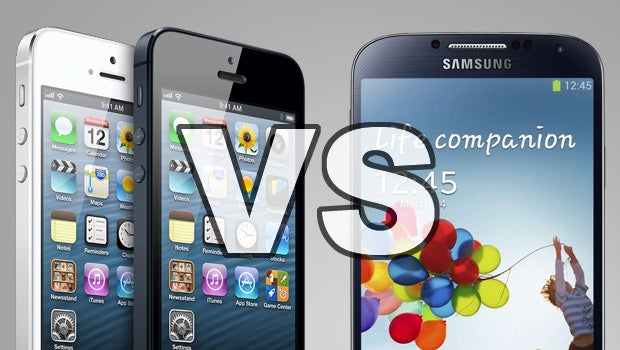
Samsung Galaxy S4 or iPhone 5 – which should you get?
The Galaxy S4 and iPhone 5 are the most successful phones Samsung and Apple have produced. They have sold tens of millions of handsets across the world.
If
you’re at the end of you contract, there’s a good chance you’ll be
looking at buying one of these phones. But which is right for you? Let’s
take a closer look as we compare design, features, speakers and
software.
SEE ALSO: Galaxy S5 vs iPhone 5S
A year on… problems and issues
The iPhone 5 and Galaxy S4 have been around for quite a while now. So are there any serious problems or issues that need to be considered?
There’s ultimately nothing too major. One of thew main recurring problems is with battery drain issues in the iPhone 5. iOS 7 has caused these to resurface – making the battery run down faster than usual.
To solve these, check out our iOS 7 battery tips feature.
Although there have been concerns raised about the build quality of the Galaxy S4, and the extent to which it is susceptible to water damage, there’s little to worry about on the Samsung front.
Update October 2013 – The Next Generation
As of September 20, the iPhone 5 has been discontinued. This was the date on which Apple launched the iPhone 5S and iPhone 5C.
Normally, Apple keeps its old models to act as a lower-cost option, but the iPhone 5 has been scrapped entirely – to be replaced by the iPhone 5C. Of course, you’ll still be able to buy it – just not directly from Apple.
The Samsung Galaxy S4 remains a ‘current’ phone, and will do so until the Galaxy S5 is released. The phone is expected to land early next year.
Want to know more about the new iPhone? Read our Galaxy S4 vs iPhone 5S comparison.

Samsung Galaxy S4 vs iPhone 5 – Video Comparison
Don’t
fancy poring over a load of text? We’ve produced a little video that
compares the Samsung Galaxy S4 and iPhone 5 side-by-side. Give it a
watch.
Samsung Galaxy S4 vs iPhone 5 – Price and deals
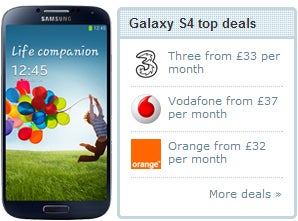
Samsung Galaxy S4 – 16GB only, From £32 a month
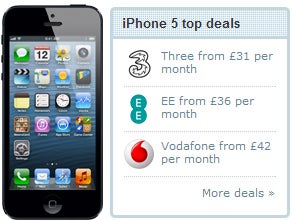
iPhone 5 – 16GB: from £33 a month
There are hundreds of contract deals available for the Galaxy S4 and iPhone 5, and they change from month to month. However, at present the phones sell at very similar prices.
Over at Carphone Warehouse, both the Galaxy S4 and iPhone 5 are available for free on contracts of £33 a month and up. Any lower than that and you’ll have to pay an up-front fee for the phone. That the iPhone 5 has been discountinued hasn’t caused the price to drop.
Go SIM-free and the Galaxy S4 is significantly cheaper these days. You can get the phone for just over £400 if you shop hard enough, while the iPhone 5 is closer to £500.

Samsung Galaxy S4 vs iPhone 5 – Design
Samsung Galaxy S4 – 7.7mm thick, plastic rear
iPhone 5 – 7.6mm thick, aluminium rear
Unlike comparing the Samsung Galaxy S4 with its Android rivals, where body shapes and sizes are similar at this high-end level, the Galaxy S4 and iPhone 5 are completely different.
It may sound trivial, but one of the most important design differences is that the Galaxy S4 is over 1cm wider than the iPhone 5. This makes it much trickier to grasp reliably than the iPhone, which is intended to fit comfortably into the hand of just about anyone.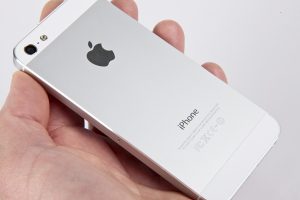
When changing the design from the iPhone 4S to the iPhone 5, Apple elongated the screen rather than making it any wider for precisely this reason.
Although the Galaxy S4 is much larger than the iPhone 5, it’s not actually any thicker – well it’s 0.1mm thicker, but even in the slimness-obsessed phone world that’s not worth crowing about.
The Samsung Galaxy S4 has a curvier body than the iPhone, which feels harder and more severe thanks to its aluminium shell and immaculate bevelled edges. Conversely, there’s no metal on the Galaxy S4’s exterior.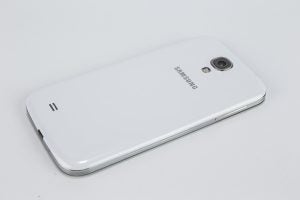
Its front is top-notch Gorilla Glass, but the rest is plastic. The phone uses a removable plastic battery cover that is frequently criticised for being flimsy or cheap-feeling.
There are a few upsides to a removable cover, though. It lets Samsung bung-in a microSD memory card slot easily and means you can replace the rear part if it gets damaged or scratched.
Replacing the housing of an iPhone 5 with an unofficial repairer online will cost you £150. A replacement battery cover for the S4 can be had for a few quid from eBay.

Samsung Galaxy S4 vs iPhone 5 – Durability
We’re generally pretty nice to the phones we review at TrustedReviews. Don’t get us wrong, we’re as critical as anything – but we don’t tend to destroy the things.
Not everyone is quite so nice. Android Authority staged a drop test, pitting the Galaxy S4 against the iPhone 5 to see which is tougher.
The Galaxy S4 was the phone to crack first, its screen smashing after a few drops. The iPhone 5 remained relatively in-tact, but it’s worth noting that its body will attract dings if you drop it – as it is made of aluminium. Give it a watch below.
Samsung Galaxy S4 vs iPhone 5 – Internal Speaker
Samsung Galaxy S4 – Mono, rear-mounted
iPhone 5 – Mono, rear-mounted
Unlike the HTC One, neither the Galaxy S4 or iPhone 5 put all that much focus on their internal speakers. Both have rear-mounted drivers that point away from you.
The iPhone 5’s speaker grilles are found on its bottom edge, put most out of view, next to the Lightning port. Cleverly, there are two grilles to help you avoid muffling the speaker with your hand.
The Galaxy S4’s speaker output has even less ceremony to it – there’s a grille cut into the bottom-left of the plastic battery cover.
But which sounds better? The iPhone 5 speaker goes that bit louder, but the Galaxy S4 copes much better at higher volumes, where the iPhone 5 starts to sound a little strained nearing top volume.
Both phones output mono sound, though, so aren’t all that great to listen to movies with.
Samsung Galaxy S4 vs iPhone 5 – Connectivity
Samsung Galaxy S4 – Bluetooth 4.0, 4G, NFC, MHL, GPS
iPhone 5 – Bluetooth 4.0, 4G, GPS
The iPhone 5 famously leaves out a few connectivity features, while the Galaxy S4 leaves out virtually nothing at all. However, if you’re not a real hardcore user you may not notice the bits left out of the iPhone 5.
Both phones have the basics – GPS, Bluetooth (with Bluetooth 4.0), Wi-Fi, 3G and even 4G.
So what’s missing from the iPhone 5? There are two biggies – NFC and MHL.
NFC is Near-Field Communication and is a wireless standard that is used in a number of different ways. The most exciting is to pay for things on the high street – although this has hardly taken off. A few coffee shops let you buy stuff using NFC, but it’ll unlikely to gain mainstream acceptance until it’s adopted by the iPhone 5S (as it rumoured).
NFC is also used to connect phones and tablets with audio docks, such as the Samsung GA-F61. These are becoming pretty common, but if your audio system is more than a year old you can be pretty much certain it won’t have NFC.
MHL is a tech that’s crammed into the microUSB slot of the Samsung Galaxy S4. With the right adapter, it lets the phone output HD video and surround sound to a TV using an HDMI cable.
However, the adapter doesn’t come in the box, and costs around £20.
Samsung Galaxy S4 vs iPhone 5 – Screen
Samsung Galaxy S4 – 1080p, 4.99-inch Super AMOLED
iPhone 5 – 640 x 1136 pixel, 4-inch IPS
The Galaxy S4 and iPhone stick to the screen technologies used by their predecessors. The iPhone 5 uses IPS, the Galaxy S4 AMOLED.
Both are huge improvements on the screens of their predecessors. Where the Galaxy S3 display was a bit dim and seemed a lot less sharp than it should have been, given its resolution, thanks to its PenTile screen type, the Galaxy S4 display is super-bright and super-sharp. 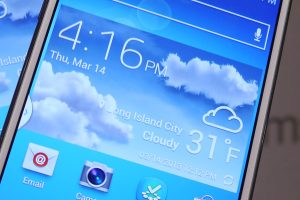
We had no real complaints about the iPhone 4S display when it was the ‘current’ iPhone, but the iPhone 5 screen makes it look a little dull, with much-improved contrast and more vivid colours.
They’re more significant generational steps-up than we were expecting – but how do they fare head-to-head? That comparison is a lot trickier.
The iPhone 5 has more natural-looking colours, while the Galaxy S4 has better contrast in low-light conditions. Although the Galaxy S4 has uses a much higher resolution, and has higher pixel density, there’s not a great difference in sharpness, though.
As both these screens are bonafide winners, the most important difference is in size, not screen quality.
The 4.99-inch display of the Galaxy is much better than the 4-incher of the iPhone 5 for playing games or watching films. We’re not totally on-board with ever-expanding mobile screens, but switching between the two, the iPhone 5 does feel flat-out small.
What you need to do it weigh-up the entertainment benefits of the Samsung’s large screen next to the negative practical issues of such a large phone.
Samsung Galaxy S4 vs iPhone 5 – Storage
Samsung Galaxy S4 – 16GB baseline, microSD slot
iPhone 5 – 16GB baseline, 32GB and 64GB models available, non-expandable
If you’re a big video or TV episode consumer, storage matters. The iPhone 5 comes in 16GB, 32GB and 64GB varieties, while the Galaxy S4 is only widely available as a 16GB model in the UK.
There’s a reason why the 32GB and 64GB Galaxy S4 editions on sale elsewhere don’t get much traction in the UK, though – the microSD memory card slot. 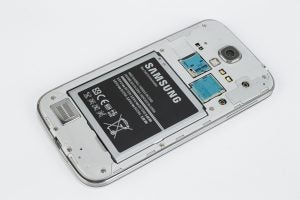
This lets you expand the memory by an additional 32GB for less than £20. To upgrade from the 16GB iPhone 5 to the 64GB version, you’re looking at spending an extra £170.
What is worth noting, though, is that the Galaxy S4 won’t let you install apps to the memory card – it’s best to leave microSD card storage for photos, videos or music.
Samsung Galaxy S4 vs iPhone 5 – CPU and GPU
Samsung Galaxy S4 – Qualcomm Snapdragon 600 1.9GHz CPU, 2GB RAM,
iPhone 5 – Apple A6 dual-core 1.2GHz, 1GB RAM, PowerVR SGX 543 GPU
Before the phone launched, it was believed that the Galaxy S4 would be the first eight-core phone. However, that version is not on sale in the UK. We can only get our hands on the more ordinary-sounding quad-core edition, which has a Snapdragon 600 1.9GHz processor.
It may not sound as impressive as the ‘octo-core’ edition, but both trump the positively passé dual-core processor of the iPhone 5.
The iPhone 5 processor is not to be underestimated, though. Its cores use the advanced Cortex-A15 architecture, and performance is solid – even when compared to more powerful-sounding quad-core rivals. The Galaxy S4 is still the clear winner, though.
Here’s how some of their benchmark scores compare:
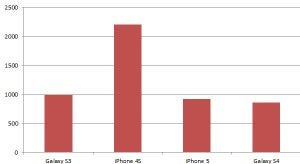
Sunspider (lower is better)
iPhone 5: 915ms
Galaxy S4: 855ms
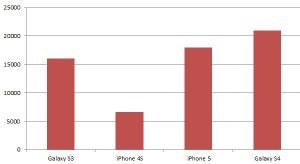
AnTuTu
iPhone 5: 18,000
Galaxy S4: 21,000
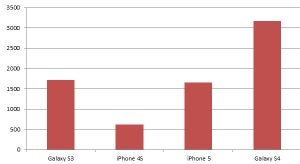
Geekbench shows the iPhone 5 is arguably closer in performance to the S3 than the S4
Geekbench
iPhone 5: 1650
Galaxy S4: 3163
Samsung’s phone is more powerful across the board, whether judging javascript performance or more general productivity/gaming prowess.
This is not surprising, though. The iPhone 5 is a more direct competitor to the Galaxy S3 than the Galaxy S4. We’ll see Apple catch up with this year’s iPhone 5S, but for now the Galaxy S4 is the power king.
Samsung Galaxy S4 vs iPhone 5 – Software
Samsung Galaxy S4 – Android 4.2 with TouchWiz
iPhone 5 – iOS 7
That the difference in raw power won’t matter all that much to people becomes clear when you get hands-on with the phones’ software. The systems they use, and the way those systems operate, is completely different. 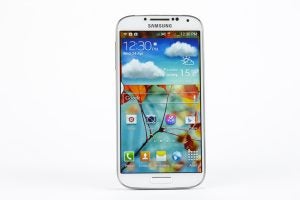
The Samsung Galaxy S4 uses a customised version of Android Jelly Bean. The custom interface that Samsung lays on top is called TouchWiz, and it looks and feels just like the one seen in the Galaxy S3 – it will seem familiar to Galaxy veterans.
TouchWiz is full of extra features. However, we did find that they tend to slow Android down a little, with a little more lag evident in transitions and app loading than we’d expect with a vanilla Android phone with a CPU this fast – or with an iPhone 5.
The iPhone 5 uses iOS 7, which was released alongside the iPhone 5S and iPhone 5C. It’s a totaly visual reworking of the iOS system. And it was long overdue – iOS had previously looked more-or-less the same as it did when it launched in 2007.
iOS 7 brings much slicker screen transitions, a more modern, clean
look and new icons. We like it. iOS 7 also has a bunch of new features,
such as the ability to turn things like Wi-Fi on and off quickly using
the swipe-up Control Center menu.
For more on the extra features found in the Galaxy S4, read our top TouchWiz features article.
Samsung Galaxy S4 vs iPhone 5 – Camera
Samsung Galaxy S3 -13-megapixel sensor, LED flash
iPhone 5 – 8-megapixel sensor LED flash
The Samsung Galaxy S4 has more megapixels than the iPhone 5, with a 13-megapixel sensor in place of an 8-megapixel one. But is it better?
The difference is not as great as you might expect. When looking at pixel level, the Galaxy S4’s pictures have a little more detail, and a little less noise in good lighting. However, the actual quality of the photos when viewed at normal sizes is roughly comparable.
Let’s take a closer look at a few photos taken with the cameras.

iPhone 5 London scene

Galaxy S4 London scene
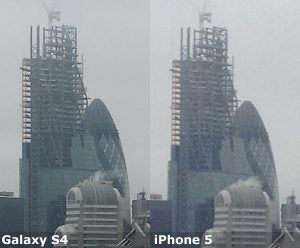
Pixel level comparion
This shot comparison gives the clearest indication of the sort of detail difference you can expect from the cameras in reasonable light. The Samsung Galaxy S4 renders some fine details far more successfully.
Check out the foreground building in the pixel level comparison. In the Galaxy S4 shot, the architectural lines between floors are clear, where they are reduced to mush by the iPhone 5. Similarly, there’s far greater detail in the lines of the Gherkin, and the scaffolding in the shot.

iPhone 5 close-up test

Galaxy S4 close-up test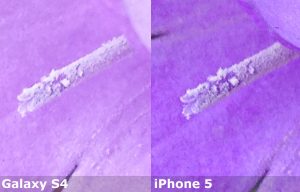
Pixel level comparison
In this second test, we tried to get up close and personal with the subject, to see how capable the phones are at macro-style photography. To start, the Galaxy S4 was much happier to focus close-up – the iPhone 5 had to be held back a little further to focus correctly.
Both phones manage a limited shallow depth of field effect, which is where the background appears blurred, bringing the subject into tighter focus. Of the two, the iPhone 5 makes a better job of bringing out the subject in question, the purple flower.
Zooming in to pixel level we see that while the iPhone 5’s image is noisier, the Galaxy S4 doesn’t render significantly more detail in the stamen, which was our exact point of focus.
Here we come to the crux of the problem – in difficult photographic situations, the Galaxy S4 won’t fare much better than the lower-resolution iPhone 5 because the camera sensor sizes are roughly the same.
One of the main reasons why a DSLR camera can take much better photos than a phone is because it uses a larger sensor. The sensor is the part that takes in light, and a larger sensor lets it reap more light in the same exposure duration. More light equals more accurate and detailed pictures.
Software is also an important part of any phone camera.
The Samsung Galaxy S4 has many more modes, filters and effects than the iPhone 5, which has only HDR and panorama. If you want to have fun with your camera, the Galaxy S4 is where it’s at – although plenty of iPhone apps that do similar things are available.
To see whether the built-in processing is of much use, we checked out these cameras’ HDR modes.

iPhone 5 HDR demo
iPhone 5 HDR demo
From a quick glance, the iPhone 5’s shot appears more lively, with greater contrast, and image ‘pop’. However, judging the HDR function alone, the Samsung Galaxy S4 is more successful.
Check out the trimmed bush to the right of the shot, and the greenery at the rear. More foliage detail is brought out of the shadows in the Galaxy S4’s photo. The exposure of the sky is a little more even in the Samsung shot too, even if all it does is to emphasise quite how drab a day we’re recreating here.
The Samsung Galaxy S4 is the camera winner, but not by quite as great a margin as we’d have liked. Let’s hope the iPhone 5S does more than catch up with the Galaxy S4.
Verdict
Several aspects show up that the iPhone 5 is a phone of last year, while the Galaxy S4 is absolutely a phone that belongs in 2013. It’s much more powerful, its camera has a full five extra megapixels at its disposal and it doesn’t even cost any more. In truth, the extras mean little in practise because there are far greater differences at work here than pure specs.
Forgetting the elements that make this comparison a case of ‘apples and oranges’, the Galaxy S4 is clearly mode advanced in most respects.
Next read our Galaxy S4 vs HTC One comparison


Editorial independence
Editorial independence means being able to give an unbiased verdict about a product or company, with the avoidance of conflicts of interest. To ensure this is possible, every member of the editorial staff follows a clear code of conduct.

Professional conduct
We also expect our journalists to follow clear ethical standards in their work. Our staff members must strive for honesty and accuracy in everything they do. We follow the IPSO Editors’ code of practice to underpin these standards.
Editorial independence
Editorial independence means being able to give an unbiased verdict about a product or company, with the avoidance of conflicts of interest. To ensure this is possible, every member of the editorial staff follows a clear code of conduct.
Professional conduct
We also expect our journalists to follow clear ethical standards in their work. Our staff members must strive for honesty and accuracy in everything they do. We follow the IPSO Editors’ code of practice to underpin these standards.