
Verdict

Key Specifications
- Review Price: £3322.35
I’ve got to admit that today is a day I’ve been looking forward to for a very long time. For it marks the arrival on our test benches of the first true second-generation incarnation of JVC’s startling D-ILA Wire Grid projection technology – a technology which caused one hell of a stir among high-end cinema aficionados and custom installation engineers when it debuted to stunning effect two years ago in the shape of the DLA-HD1.
The thing – or at least, the main thing – that makes D-ILA Wire Grid technology so intriguing to movie fans is the way it can deliver truly cinematic contrasts and black levels without the need for a dynamic iris of the sort required by LCD projectors, Sony’s similar SXRD projectors, and even one or two recent DLP projectors.
In other words, the new DLA-HD350 doesn’t need to reduce the brightness of the image to produce convincing, grey-free blacks during predominantly dark scenes, and so can produce images that look much more consistent and dynamic.
What’s more, not needing a dynamic iris also aids the image’s stability, since you don’t have to worry about seeing obvious brightness ‘jumps’ as a dynamic iris tries to adjust the light output in real time in response to the image content being shown. A further fringe benefit still is the lack of any mechanical noise that might be caused by a dynamic iris constantly opening and closing.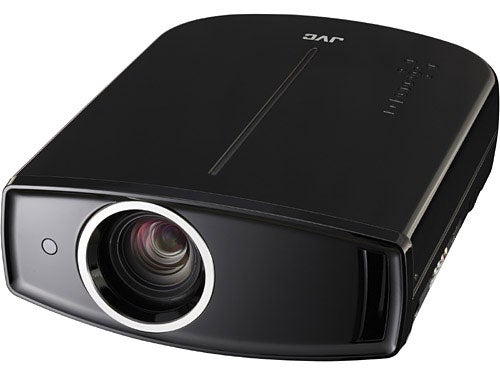
The strange thing about all this, in some ways, is the fact that it’s JVC’s D-ILA technology that’s delivered such a contrast coup. For while D-ILA has in fact been round for quite a number of years now, prior to the HD1 it had always looked like an over-priced ‘also-ran’, particularly because, ironically, it lacked the black level response of rival technologies.
The thing that changed with the HD1 was the addition of the Wire Grid optical system to the DLA spec. Trying to keep an explanation of this as simple and brief as possible given that we’ve covered it in previous reviews, the Wire Grid Optical Engine is effectively an ultra-efficient replacement for the normal glass prism polariser/multi-layer interface optical system. It works by placing aluminium ribs with precise spacing onto a flat glass substrate mounted on an inorganic reflective polarising plate, producing a grid effect that hugely reduces the angle dependency for polarised light. The result is a substantial drop in light leakage within the optical array, and much better black levels during dark scenes.
It’s worth saying, too, that further light efficiencies have been delivered by improvements in the manufacturing process of the D-ILA chipsets, with new ultra-smoothing technology reducing irregularities in the liquid crystal alignment. And all the projector’s 1,920 x 1,080 pixels are fitted onto a tiny 0.7in D-ILA device with a gap between each crystal of just 2.3 microns – yet another fact that helps keeps more light focussed onto your screen and less bouncing around inside the optical engine, polluting black levels.
Sorry about all this background tech so early in a review, but it’s really impossible for me to set the scene properly for the HD350 without making you aware of what makes it tick, technologically speaking.
What’s more, we can now turn to rather simpler matters: the HD350’s looks. These are an improvement over the previous HD1 and HD100 models, as a very glossy black body wraps itself elegantly in a vaguely diamond shape around the extremely large lens and optical barrel.
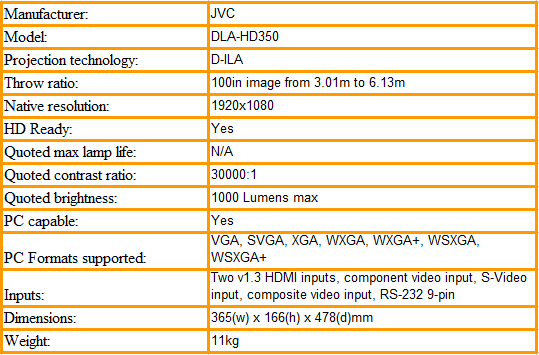
When it comes to connections, the HD350 is perhaps a touch disappointing. The main reasons we say this are the presence of only two v1.3 HDMIs when I’d have perhaps liked to find three on such a movie-loving projector; the absence of a dedicated D-Sub PC input; and the lack of a 12v trigger output. The DLA-HD750 model that sits higher up JVC’s new D-ILA range provides both these missing jacks, but surely it wouldn’t have been too much to ask for them to be included on the HD350 as well?
On the upside, you do get an RS-232C port for system integration – the sort of thing that’s pretty much essential for any projector hoping to appeal to the custom installation market as much as the HD350 doubtless does.
Custom installers will probably also appreciate the big advances the HD350 makes in terms of both the flexibility and simplicity of its set up. A much improved onscreen menu system, for instance, gives easy access to motorised vertical and horizontal image shifting, motorised zoom (over an excellent x2 optical range), and motorised focus options, all tweakable with the help of a simple geometrical test pattern.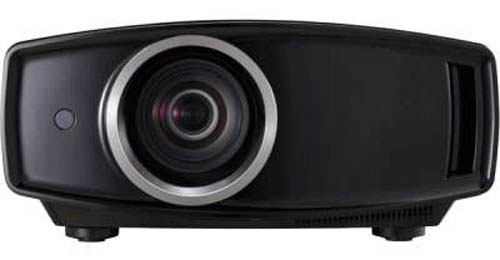
There’s also keystone correction to help correct the sides of the image if the projector is offset from your screen vertically or horizontally – though I’d recommend you try and use the shifting facilities rather than involving yourself with the inevitable digital distortions of the keystone system.
Another handy touch is a really sensibly calibrated series of image presets, including two Cinema modes and a Stage mode. In addition there are three User memory slots where you can store preferred settings for different source types, a blindingly simple colour temperature adjustment that includes 5800K, 7500K, 9300K, and High Bright options, along with the key 6500K setting always reckoned to be best for video viewing, and three custom options.
Then there is a series of Gamma presets, as well as another three customisable options, and plenty of flexibility in the image’s sharpness setting, complete with a detail enhancement processor.
And still there’s more, with a three-step aperture adjustment allowing you to adjust the amount of light output through the lens. Just to make sure you’re clear on this, the aperture adjustment is a manual system with which you can adjust the overall brightness tone of the picture; it’s not any sort of automatic system the projector has to use during films to keep maximising its contrast. As we stressed earlier, the HD350 can deliver its contrast without any dynamic iris trickery.
Final more minor bits and bobs include the key facility to deactivate any overscanning, for scaling-free pixel by pixel renditions of full HD sources; and the ability to switch the lamp between high and low output levels. Provided you’ve got a properly blacked out cinema room, we’d recommend you stick with the low output here, as it makes a really big impact on the amount of running noise the projector produces. Indeed, the 19db or so emitted with the lamp set low makes the projector practically inaudible, unless your seating position happens to be right next to it. The single most important thing about all this flexibility within the JVC’s menus, though, is the fact that they provide mere fine-tuning of what are at heart already stunning pictures.
I have to admit that I’d half feared the HD350 wouldn’t really be able to improve sufficiently on the HD1 to win me wholeheartedly to its cause. But the improvements are not only there, but pronounced.
Black levels, for instance, are even more profound. In fact, so superbly deep, stable, rich and free of grey misting and noise are dark areas of the HD350’s pictures that they make the 30,000:1 native contrast claim seem slightly conservative. This can be seen in particular during the night-time sequence where Bond’s Aston Martin chases Le Chiffre and Vesper in Casino Royale, only to end up barrel rolling along the road after Bond loses control. I’ve never seen any projector for anywhere near the HD350’s price reproduce this scene so effectively, in terms of both the depth of black level achieved and the amount of shadow detail visible in the dark backdrop. 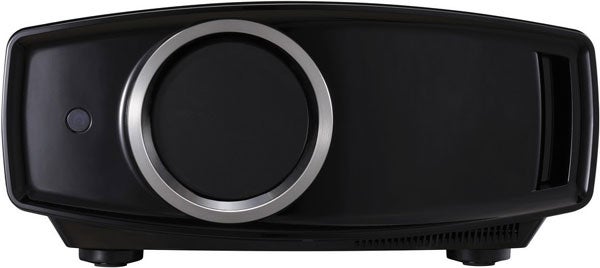
This sort of shadow detailing gives dark scenes a superb sense of scale, depth and realism way beyond anything commonly found for less than £5k. And it’s only possible because the HD350 doesn’t need a dynamic iris, and so does not have to reduce the brightness of its image in order to render the darkest parts of the image convincingly. In other words, it’s hard to imagine any LCD or current SXRD projector being able to deliver so winning a combination of black level and brightness.
It’s just about conceivable that a really good DLP projector might be able to serve up similarly dynamic images. But then any that did so, like, perhaps, the InFocus IN83, would also suffer with that dreaded DLP problem of the rainbow effect, where stripes of pure red, green and blue flit around over particularly strong areas of bright/dark contrast. Since the HD350 doesn’t depend on a colour wheel like DLP technology, it suffers no rainbow side effects at all.
In fact, I failed to detect any noise or artefacts at all that might be connected with the D-ILA technology, be they motion blur, rainbowing, evidence of visible pixel structure in the final image, dot noise, poor contrast, flickering brightness levels and so on. And actually, for me, this seeming immunity to technology-induced noise is as big a strength as the HD350’s class-leading black levels, ensuring that there’s nothing getting between you and total immersion in what you’re watching.
The HD350 follows in the groundbreaking footsteps of the HD1, meanwhile, by serving up jaw-dropping amounts of sharpness and fine detailing. During Casino Royale I actually noticed levels of skin detail in Daniel Craig’s face I’d never noticed before, as well as new levels of pixel detail in the screen of the computer Bond uses in M’s apartment.
What’s more, this remarkable clarity isn’t accompanied by any sort of grittiness, as we find with some other very sharp projector pictures. And the HD350 doesn’t need any help from any sharpness enhancement processing, either; everything you see is just the HD350 reproducing what’s there on the disc with total precision.
If the HD1 and even the later, higher spec HD100 JVC D-ILA models had any faults, it was that they didn’t produce especially bright pictures, and couldn’t produce colours as rich as those of the best DLP models. But the HD350 makes great strides in both departments, achieving brightness levels (up from the HD1’s 800 Lumens to 1000 Lumens) that comfortably satisfy our 110in screen, and colours that look intense and radiant but also, for the most part, superbly natural in tone. 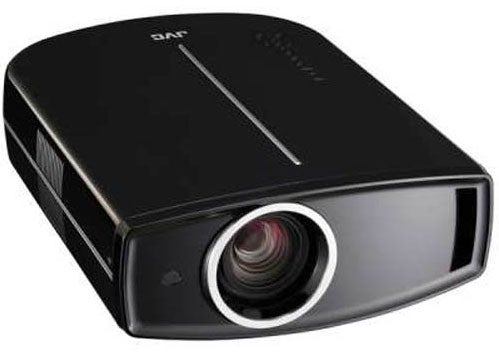
Add to the already mesmerising HD350 picture mix totally sharp, blur-free motion reproduction, natural unforced edges and some of the best standard definition pictures we’ve seen on a projector thanks to the unit’s use of Silicon Optix’s HQV Reon-VX video processing engine, and you really are talking about a pretty much perfect package.
Really the only area where I feel there’s any significant room for improvement on the HD350, given its price, is in the colour department. For while colours are generally outstanding, my eye was caught by the very occasional appearance of a slightly rogue tone.
Setting the Gamma level to its B preset seemed to minimise this issue, but if money’s no object, boosting the colour performance might be just enough of a reason for you to save up for the upcoming HD750, which will add an extremely sophisticated colour management system to the feature mix. Needless to say, the extra colour management will also make the HD750 the model of choice for most high-end custom install specialists.
”’Verdict”’
The DLA-HD350 is a simply stunning projector that continues to prove the extreme potency of JVC’s D-ILA Wire Grid technology. In fact, it’s so good that I’d have recommended it wholeheartedly if it cost five grand. So at less than £3.5k it’s nothing short of a home cinema steal.
Trusted Score
Score in detail
-
Value 10
-
Features 8
-
Image Quality 9
-
Design 9


Editorial independence
Editorial independence means being able to give an unbiased verdict about a product or company, with the avoidance of conflicts of interest. To ensure this is possible, every member of the editorial staff follows a clear code of conduct.

Professional conduct
We also expect our journalists to follow clear ethical standards in their work. Our staff members must strive for honesty and accuracy in everything they do. We follow the IPSO Editors’ code of practice to underpin these standards.
Editorial independence
Editorial independence means being able to give an unbiased verdict about a product or company, with the avoidance of conflicts of interest. To ensure this is possible, every member of the editorial staff follows a clear code of conduct.
Professional conduct
We also expect our journalists to follow clear ethical standards in their work. Our staff members must strive for honesty and accuracy in everything they do. We follow the IPSO Editors’ code of practice to underpin these standards.