
Verdict

Key Specifications
- Review Price: £15995.00

(centre)Best Projector(/centre)
LED looks like it could well become the de facto lighting system for LCD TVs. There just seems to be no arguing with its combination of enhanced performance and extra ecological benefits. And now LED is also making a very strong case for itself in the projection world too. At the low end of the scale LED lamps have made a whole new product category of ‘pocket’ projectors possible. But it’s at the high end where things have really got exciting, as evidenced first by Vivitek’s outstanding H9080FD, and now by Sim2’s jaw-droppingly good MICO 50.
At the heart of the MICO 50 sits a 0.95in, 1080p DarkChip4 Texas Instruments single-chip DMD – a chipset you might well find in any any number of good quality DLP projectors. But it’s what feeds this chipset with its light that matters, namely three Luminus Phatlight (love that name) PT120 LEDs – one each for the red, green and blue colour elements.
Having three separate light sources crucially removes the need for the colour wheel system generally needed in single-chip DLP projectors. This means that the MICO 50 shouldn’t suffer with the dreaded, colour wheel-created ‘rainbow effect’, where stripes of pure red, green and blue can be seen over bright picture elements, or in your peripheral vision.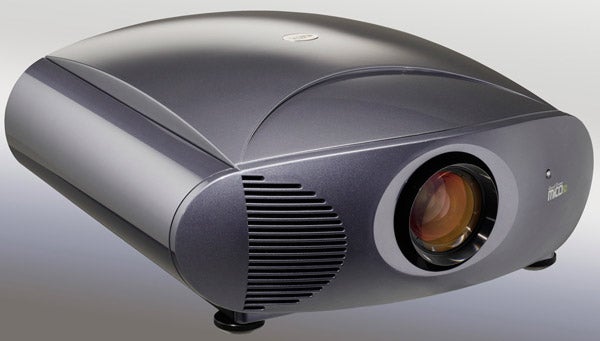
In fact, Sim2 reckons the effect of the switching-LED lighting is roughly equal to a 7x colour wheel spinning seven times faster – or a 49x colour wheel, if you will! As a result other colour wheel problems, like colour smear and blur, should also vanish without a trace.
Using LED lighting in the MICO 50 has a number of other major benefits too. First, as we’ve noted before, LED lighting produces a wider colour gamut than ordinary projection bulbs, making for more intense yet also accurate colourscapes. Next, the ability of LED lamps to be pulsed extremely rapidly means they can achieve an active colour cycle of 20x per frame of image content, eliminating sequential colour artefacts, and boosting contrast, colour and greyscale accuracy – all without damaging the lamps’ overall lifespan or image quality.
The MICO 50’s LEDs are driven by an 8-bits-per-channel high speed current driver which can balance the three LED modules’ light intensity courtesy of a sensor positioned within the light engine. The driver can deactivate the 30A current to each LED in under one microsecond. Even faster than I can polish off a Dairy Milk, in other words. And that’s saying something.
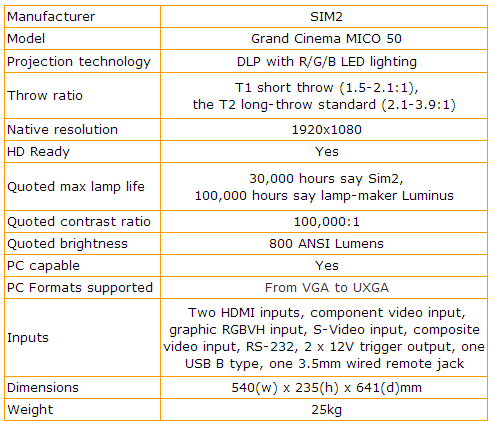
Another big LED advantage evidenced by the MICO 50 concerns that lamp lifespan we mentioned earlier. For LED lamps last far longer than normal projection lamps. In fact, according to Luminus, the LEDs in the MICO 50 should last for a truly remarkable 100,000 hours. Sim2 more conservatively pitches the lamp life figure at around 30,000 hours. But compare either of these figures with the 2000-4000 hours of a standard projection bulb, and you can see why it’s such an important feature. For some users it might actually be fair to say that the lamps in the MICO 50 will last for the lifetime of the projector, making it a maintenance-free option.
Not having to buy replacement lamps every few thousand hours also makes the MICO 50 quite cost effective in the long term – notwithstanding the fact that it will have cost you the best part of £16k up front, of course! And let’s not forget, either, the ecological benefits of not having to keep replacing lamps.
Continuing the green theme, the MICO 50 employs no mercury or lead in its construction, uses less than 1W in standby, and also runs far more efficiently than a normal projector – not least because it impressively employs a liquid cooling system, drastically reducing the effort needed from the two onboard fans. This fact also makes the MICO 50 exceptionally quiet to run for such a powerful machine – as well as making it much less likely to turn your living room into a sauna during a movie marathon.
With a mighty claimed contrast ratio of 100,000:1, a claimed colour palette of 200 trillion colours and Sim2’s own PureLED video processing on top of all the LED benefits described earlier, it’s fair to say that the MICO 50 has already gone a mighty long way towards justifying its high price. But we’re not done yet, for it can also be calibrated to within a millimetre of perfection courtesy of Sim2’s outstanding Live Colour Calibration software. 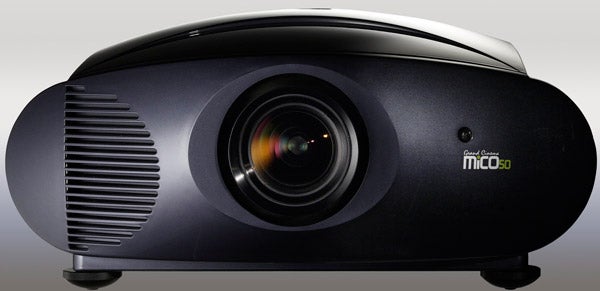
I won’t go into detail on this here, as I covered it in an earlier review of Sim2’s C3X Lumis. Suffice it to say that it makes the usual ‘built-in’ colour management systems look positively amateurish by comparison.
The MICO 50’s connections go further than your average projector too. For as well as the expected couple of HDMIs, you get all the usual ‘legacy’ stuff (composite, S-Video and component inputs) and a host of bits and bobs designed to aid the custom installation market at which the MICO 50 is so clearly targeted. RS-232 serial and USB ports, 12-volt trigger outputs, IR sensor inputs, and anamorphic projection functionality… they’re all there.
If like my dear old nan you’re one of those people who likes quantity as well as quality for your buck, fear not. For the MICO 50 is an absolute beast of a machine, measuring 540 x 235 x 641mm and weighing a disc-slipping 25kg.
I have to say that at first I didn’t think its design delivered Sim2’s usual penchant for Ferrari-esque beauty. But weirdly the design grew on me with every day that I spent with it, as I really started to appreciate the glorious quality of its glossy finish, and the way all of its high-spec items – its lens array, its cooling vents, its liquid cooling chambers, its LED optics and so on – have been incorporated without completely losing that blend of curvaceous fun and refinement that the Italian brand has made its trademark. In fact, by the time I reluctantly handed the MICO 50 back to Sim2, I’d started to see it as a minor masterpiece of industrial design.
Of course, it’s entirely possible that my growing feelings of admiration for the MICO 50’s design may have sprung from my deep adoration of its performance – if ever an AV product had the performance skills to actually inspire love in anyone lucky enough to own it, it’s the MICO 50.
It gets so many things so very, very right with its pictures that I actually found trying to break the image quality down into its constituent parts quite difficult. The picture seems so organic, well-rounded and natural that you just sink into it, without easily being able to separate out its various elements. Luckily I had the projector for a whole week, though, and hammered it to death in that time, so I was finally able to get some thoughts together beyond ‘holy s**t, it’s good’…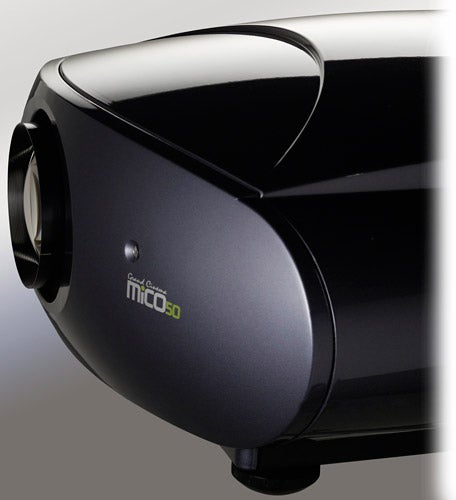
Let’s start with a surprise: the image’s brightness. The on-paper brightness figure quoted for the MICO 50 is a fairly uninspiring 800 ANSI Lumens. Yet its image positively exploded off my screen; so much so that for the first time in the year my new test room has been built, I found myself getting annoyed that the walls are painted white. You see, the image hit my screen with such ferocity that it bounced back onto the surrounding walls enough to reduce the impact of the projector’s fearsome black level response – at least where scenes contain a mix of bright and dark material. Hmm. I wonder if I could work in a room painted matt black, or if that would just drive me even more round the bend?…
I can only put the discrepancy between the MICO 50’s quoted brightness and the actual experience of watching it down to the LED light engine at the projector’s heart. And anyway, it just goes to show yet again that you should never make judgments based on manufacturers’ quoted specifications.
What makes the MICO 50’s brightness all the more remarkable is that it’s accomplished at exactly the same time as it produces some of the deepest black levels I’ve ever seen from a home projector. Unlike the brightness figure, the 100,000:1 contrast ratio claim doesn’t seem at all unrealistic, as the MICO 50 projector achieves depths of blackness – without sacrificing shadow detail and image depth – that humbles all rivals save Vivitek’s own three-LED H9080 and possibly the top models of JVC’s D-ILA range.
The MICO 50’s talents continue with its truly mesmerising sharpness and knack for reproducing detail. In fact, we have our suspicions that some source providers might actually grow to have a healthy dislike of the MICO 50, for it’s so unerringly precise that it is completely unforgiving of any weaknesses sources – even, actually especially HD ones – may show.
While watching Sky HD, for instance, I was actually quite disturbed by how God-awful David Fincher’s The Game looked in HD. In fact, there was so much noise and even compression blocking that the picture looked more like an upscaled DVD on the MICO 50 than an HD broadcast.
Yet switching to Valkyrie on one of Sky’s other HD movie channels revealed it to have a much, much better picture; one still prone to a little grain, but which certainly looked like the genuine HD article.
This ability of the MICO 50 to relentlessly pick the HD wheat from the chaff extends to Blu-ray too. I don’t mean this to appear a fault of the projector, of course. Quite the contrary; my point is simply that the MICO 50’s pictures are so sharp and pure that they leave no hiding place for dodgy transfers or low bit-rate broadcasts. 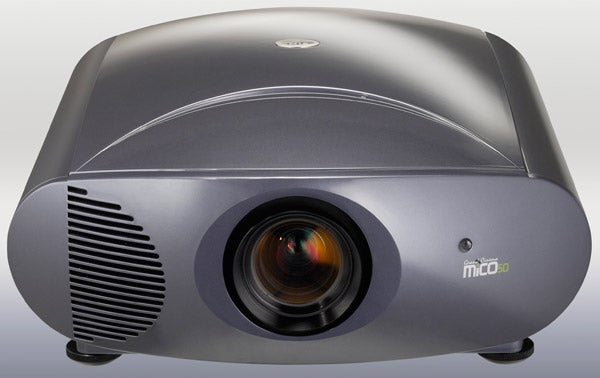
The obvious upside to the MICO 50’s dazzling clarity, apart from showing who knows how to ‘do’ HD well and who doesn’t, is that it delivers enough extra insight into your favourite Blu-rays and HD recordings to make you feel like you’re seeing them properly for the first time. Any product able to create this ‘making things new again’ high in a reviewer who’s tested thousands of TVs and projectors can certainly be considered very special indeed.
The sense that you’re gaining an extra insight into pictures with the MICO 50 continues with its colour response. Projectors able to produce a similar level of tonal accuracy, blend smoothness and vibrancy are very, very rare. I noted in the review of Vivitek’s H9080 how outstanding colours appeared to be on LED projectors, but the MICO 50’s subtlety, finesse and expressiveness take this argument up another gear.
In fact, the MICO 50’s outstanding abilities with colour will likely make going back to testing the more affordable projectors that I usually spend my time with a bit difficult. I guess I’ll have to see a few all at the same time to get my sense of perspective back on track!
One of the last picture strengths to become clear to me while reviewing the MICO 50 is actually one of its strongest: motion handling. The thing is, the MICO 50 handles motion so effortlessly from whatever sort of source you throw at it that you completely forget that motion normally causes most displays a few problems – especially in these days of 1080p/24 Blu-rays.
There’s no blurring whatsoever, no transient noise that I could see, and best of all, no distracting judder. Also, however, the image doesn’t go processing crazy and try to produce a picture that moves so silkily smoothly that it looks nauseating and unnatural. Instead you just get an image that looks pretty much exactly like something you’d see in a commercial cinema. And you can’t say fairer than that.
With the MICO 50 also doing a startlingly smart job of upscaling standard definition (it’s actually more forgiving of standard def than it is poor-quality HD), finding things not to like about the MICO 50 is a pretty thankless task. Aside from the fact that it costs more than I’ll likely ever be able to afford, of course! 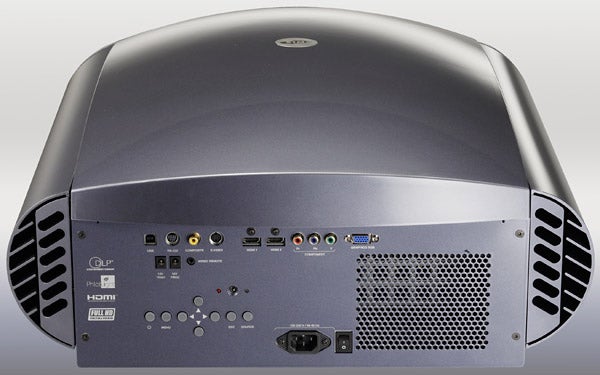
I guess there’s a tiny bit of DLP dot noise visible during really dark shots – though you have to practically have your face pressed to your screen to really be distracted by this. I’m also no fan of Sim2’s operating system, finding the onscreen menus rather technical and unfriendly, while the remote control far more basic than such a projector deserves.
However, it doesn’t make a great deal of sense to dwell on this latter point, since the Sim2 will doubtless be professionally installed for you when you buy it; you won’t just be sent one and expected to sort it out for yourself. In fact, it will likely more often than not become part of a much larger installation, where it will be controlled via a fancy third-party control device from the likes of Crestron.
For this same reason I haven’t gone into my usual detail in this review on how the MICO 50 is to set-up – though I might as well say in passing now that I’ve mentioned it that with its fully motorised image shifting, zoom and focus, built-in test signals and long and short-throw lens options, it’s actually extremely easy to install.
Let’s wrap up, though, by getting back to the only thing that will really matter to the MICO 50’s likely buyers: its truly amazing pictures. If you want to achieve the aficionado’s dream of being able to see an HD picture on your projection screen that looks exactly like it did when it was mastered or broadcast, or a standard def picture that looks better large than you could ever have expected, this Sim2 is for you.
”’Verdict”’
The MICO 50 might be Sim2’s first foray into LED waters, but the Italian brand has absolutely nailed it. With its amazing build quality, excellent custom install flexibility, extreme colour management and almost other-worldly picture quality, it’s an absolute poster boy for what LED can do.
Trusted Score
Score in detail
-
Value 8
-
Features 10
-
Image Quality 10
-
Design 9


Editorial independence
Editorial independence means being able to give an unbiased verdict about a product or company, with the avoidance of conflicts of interest. To ensure this is possible, every member of the editorial staff follows a clear code of conduct.

Professional conduct
We also expect our journalists to follow clear ethical standards in their work. Our staff members must strive for honesty and accuracy in everything they do. We follow the IPSO Editors’ code of practice to underpin these standards.
Editorial independence
Editorial independence means being able to give an unbiased verdict about a product or company, with the avoidance of conflicts of interest. To ensure this is possible, every member of the editorial staff follows a clear code of conduct.
Professional conduct
We also expect our journalists to follow clear ethical standards in their work. Our staff members must strive for honesty and accuracy in everything they do. We follow the IPSO Editors’ code of practice to underpin these standards.