
Verdict


Pros
- Outstanding 2D images
- Excellent value
- Endless setup options
Cons
- Doesn't ship with any 3D glasses
- Slight crosstalk with 3D
- 3D images take a big brightness hit vs 2D
Key Specifications
- Review Price: £2900.00
- Active 3D playback
- LCD projection technology
- 2400 Lumens brightness
- 500,000:1 claimed contrast ratio
- x2 optical zoom and extensive image shifting
Introduction
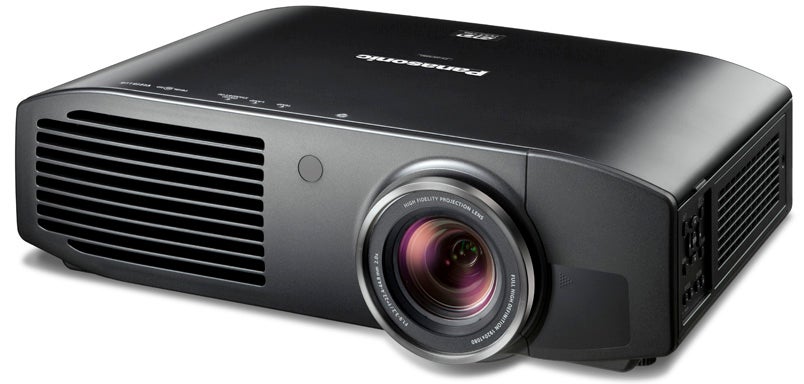
These are exciting times for home cinema fans. For as well as brilliantly promising but also affordable new 3D-capable projectors from JVC, Sony and Epson heading our way in the coming weeks, today we’ve got our hands on the first of the new projector ‘wave’: the Panasonic PT-AT6000E (often listed as the Panasonic PT-AT6000).
The Panasonic PT-AT6000E follows on from 2011’s well-received Panasonic PT-AT5000E, but the extent to which it advances on its predecessor is impressive.
Perhaps the single most important enhancement is that the Panasonic PT-AT6000E uses a new 220W red-rich lamp that raises light output to 2,400 Lumens – a 20 per cent increase over the Panasonic PT-AT5000E. This could go a very long way to tackling the lack of brightness noted with the AT5000E’s 3D pictures. Such a boost in brightness could have a significant impact on 2D pictures too, of course – especially as the light output rise is accompanied by a healthy-looking rise in the Panasonic PT-AT6000E’s claimed contrast ratio, which hits 500,000:1 versus the AT5000E’s 300,000:1.
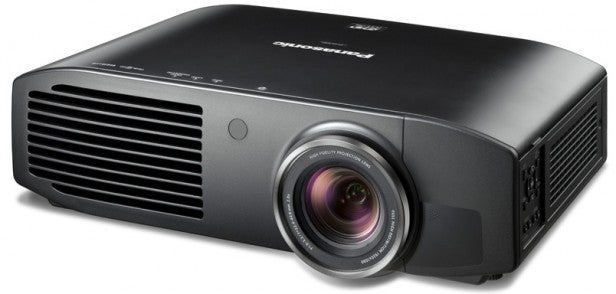
These two improvements alone should be enough to help the Panasonic PT-AT6000E produce markedly punchier and more dynamic pictures than those of the Panasonic PT-AT5000E – a projector which itself won praise for its dynamism, at least with 2D playback.
Panasonic PT-AT6000E Specs
The amount of technology the Panasonic PT-AT6000E applies to its pictures is actually pretty staggering for a projector we’ve seen selling for £2,900. For starters, Panasonic has completely redesigned its lamp module, so that it can better dissipate the extra heat generated by the more powerful 220W lamp without simply making the projector’s fans run harder (and thus more noisily).
Panasonic has also introduced new condenser lenses with special coatings designed to boost colour response by cutting out all unwanted light frequencies, while a new Pure Contrast Plate system in conjunction with an improved dynamic iris are largely responsible for the boosted contrast figure noted earlier.
There’s a new version of Panasonic’s Detail Clarity Processor within the Panasonic PT-AT6000E too. This claims to be much more intelligent than usual sharpness-boosting engines in that rather than just boosting the sharpness of the whole image – which can actually reduce an image’s depth – the Detail Clarity Processor figures out which parts of a source image are using softness to create an illusion of depth, and leaves them relatively alone. This sort of ‘non-universal’ approach to sharpness boosting is particularly important with very high-brightness projectors like the Panasonic PT-AT6000E.
The Panasonic PT-AT6000E also goes the extra mile to suit AV enthusiasts by including among its picture presets a Rec709 setting that gives you the exact colour spec of the industry HD TV standard. Though, as an interesting counter to the notion that slavishly following ‘industry standards’ always delivers the best picture results, Panasonic has found that the Rec709 settings – which are based, after all, on 42-inch HD monitors, not projectors – didn’t work quite right in a projection situation. As a result, the brand has provided a suitably tweaked version in the shape of the projector’s Cinema 1 preset.
Focussing on the work done to boost the Panasonic PT-AT6000E’s 3D performance, as well as the key brightness boost already covered, Panasonic has introduced a new temperature control system to tackle the way 3D crosstalk ghosting tends to be worse before projectors get fully warmed up. Also introduced to the AT6000E is the same 3D motion remaster system Panasonic launched on its 2012 TVs. This does a subtle but welcome job of removing the ‘bulging’ effect that fast motion can cause when watching 3D.
The Panasonic AT6000E is equipped with LCD panels designed to run at 480Hz to boost 3D performance, and which use vertically aligned liquid crystal molecules with inorganic alignment layers to minimise accidental light leakage and thus boost contrast.
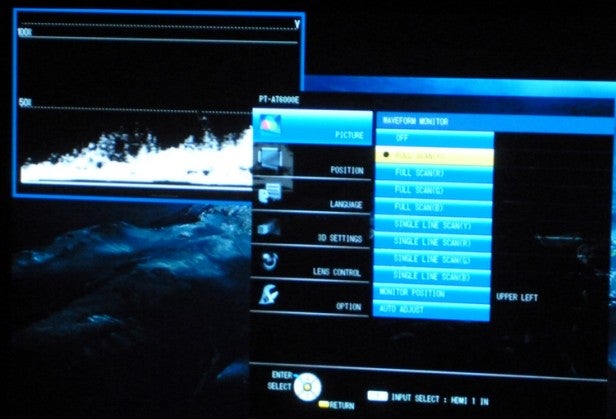
Then there’s the almost crazy amount of fine tuning adjustments for both 3D and 2D content included within the Panasonic PT-AT6000E’s intimidating onscreen menus. Trying to go through every tweak on offer would take us all day, and would also in our opinion be rather pointless, as it’s our belief that many of the subtler adjustments on offer will never be touched by the vast majority of users.
Panasonic PT-AT6000E Features
Among the more useful of the Panasonic PT-AT6000E’s calibration tools, are advanced gamma adjustments available in both 2D and 3D mode; a full colour management system; and the ability to monitor and adjust the 3D image’s parallax level should you find the default settings too tiring with a particular film. Though purists, of course, will prefer to leave a film’s 3D settings at their default ‘as-mastered’ levels.
Also extremely handy for people with 2.35:1-ratio screens is the Panasonic PT-AT6000E’s lens memory function, which can store different lens settings for different aspect ratios. Unlike the Panasonic PT-AT5000E, this system also works with 3D content too.
If you’re feeling alarmed by the potentially complicated setup stuff we’ve just waded through, don’t worry: when it comes to just getting its pictures positioned in the right place and at the right size on your screen, the Panasonic PT-AT6000E is actually blindingly simple. Well, mostly…
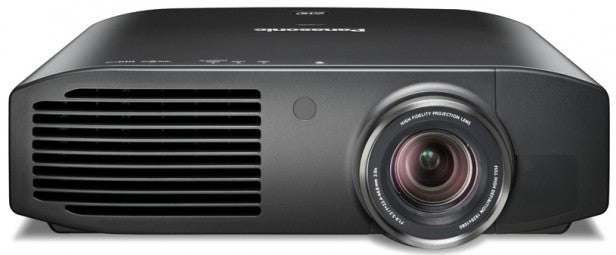
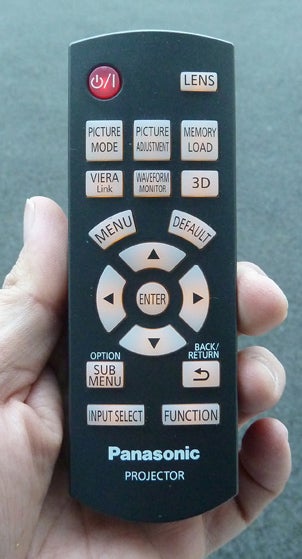
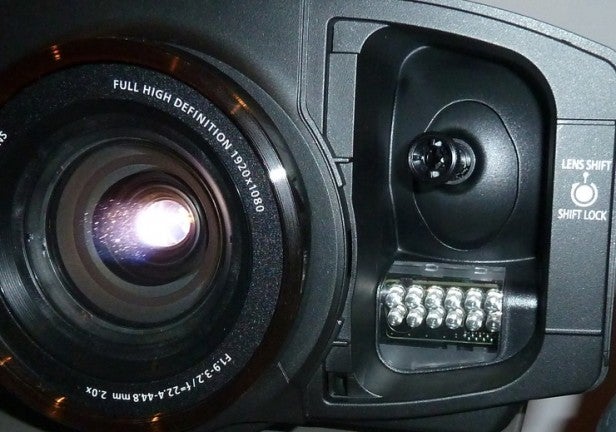
For starters, the projector enjoys a hugely helpful 2x optical zoom, making it adaptable to many room sizes and set-up positions. Its vertical and horizontal image shift, meanwhile, is achieved simply by moving a joystick tucked under a cover to the right of the lens. As for focus and zoom, both are motorised, with control via the small but hefty, backlit and well thought-out remote control. The patterns generated to help you optimise focus for both 2D and 3D images are both unusually good too.
The only niggle we found with this level of set up is that the shift joystick is too stiff and unresponsive, making it very tricky to try and achieve small image movements.
Given how much effort Panasonic has apparently poured into the 3D performance of the Panasonic PT-AT6000E, there are a couple of 3D-related points about the device that seem a little odd. First and worst, you don’t get any of the necessary TY-EW3D3ME active shutter glasses free with the projector, so you can’t actually use its supposedly important 3D talents without finding around £80 for each pair of 3D glasses you need.
The other slight surprise is that Panasonic has stuck with the IR transmission system for its 3D glasses signals rather than moving to the RF system generally considered to be more stable – especially in the sort of large, multiple-viewer environments projectors are more likely to be used in.
To be fair regarding this latter point, though, we did a test viewing with three viewers in a 5.5m x 4.5m room, and once everyone was settled into place we got through an entire two-hour film without anyone suffering a single lost glasses connection.
Panasonic PT-AT6000E 2D Performance
Having talked so much about 3D, the 2D abilities of the Panasonic PT-AT6000E’s lead the show and to say we were impressed by this two-dimensional capabilities would be a major, major understatement.
The Panasonic PT-AT6000E exceeds the already terrific 2D efforts of the Panasonic PT-AT5000E on practically every level, kicking off with the image’s contrast, which manages to combine deep, natural black colours with extremely bold whites and potent colours – all within the same frame. This is a seriously outstanding achievement from an LCD projection engine.
Prior to the Panasonic PT-AT6000E, the only brand that’s been able to deliver so convincing a black level and contrast performance for less than £5,000 is JVC, with its outstanding D-ILA line of projectors that includes the JVC DLA-HD950 D-ILA. Having referenced JVC here we must stress that JVC achieves its gorgeous black level response ‘natively’, meaning it doesn’t have to use a dynamic iris like the Panasonic PT-AT6000E. However, the dynamic iris in the AT6000E is so fast and well-calibrated that we saw hardly any sign of the sort of instability and brightness ‘jumping’ during dark scenes usually associated with dynamic iris systems.
Also beggaring belief for its price level is the amount of shadow detail contained in dark areas of the Panasonic PT-AT6000E’s pictures. This proves just how much the projector’s black response is down to the sheer quality of its optical engine, for if it was achieving its black depth simply by removing loads of light from the image, far more shadow detail would get crushed out.
Regular readers will know that our current favourite test sequence for black level response is the beginning of Chapter 12 on the Harry Potter and the Deathly Hallows Pt II Blu-ray, and The Panasonic PT-AT6000E handles this entire sequence quite brilliantly, combining its lovely deep blacks with enough shadow detail to let you see the individual outlines of all of Voldemort’s followers on the night-time hilltop; lots of detail in the extremely dark shot of Hogwarts in the valley blow; and even details of the hills behind Voldemort.
To be clear, most TVs struggle to show all these subtleties and details on a small scale, yet here we have an affordable LCD projector not only presenting pretty much everything this incredibly dark scene has to offer at 90-inches and more, but doing so with total stability and without a trace of the light uniformity issues that you get with most TVs.
Not that the Panasonic PT-AT6000E is only about a brilliant contrast performance, though. It also performs superbly where colour is concerned. The red-rich lamp Panasonic has used helps the AT6000E deliver the slightly warm tone that generally works best for accurate video rendition versus the slightly cool look LCD tech generally leans towards.
The colour range is extreme, meanwhile, and Panasonic’s latest colour processing engine delivers bags of finesse when it comes to colour blends and tonal shifts. Especially, we’re impressed to report, with skin tones. Wrapping up a really terrific 2D video performance is an impeccable approach to sharpness and detail – courtesy in part of Panasonic’s Smooth Screen technology.
The Panasonic PT-AT6000E lets you see even the finest nuance and detail in such HD specialities as a suit texture, head of hair, or tree-filled long-distance view. But crucially it does this without forcing the sharpness to the point where grain becomes excessive or edges look stressy. The result is a picture that looks effortlessly engaging and cinematic, even with notoriously ‘fizzy’ and even noise-reduced transfers such as – again – the Harry Potter disc. To be clear here, we’re not saying the Panasonic PT-AT6000E gets rid of natural film grain. It just handles it more naturally than many rivals.
The Panasonic PT-AT6000E’s sharpness remains intact when there’s motion in the picture too, and we were also pleasantly surprised by how little judder there is, even if you don’t bother with the Frame Creation motion compensation processing system the projector carries.
The final remarkable aspect of the Panasonic PT-AT6000E’s 2D performance is how bright it is. Even using its Cinema presets it manages to look notably brighter than the preceding AT5000E, raising it to a level that would previously have been unthinkable on an affordable projector still capable of producing a brilliant black level response.
Panasonic PT-AT6000E 3D Performance
All in all, the Panasonic PT-AT6000E’s 2D performance is so good it frequently caused us to simply shake our heads in amazement. However, while its 3D images are also substantially better than those of the Panasonic PT-AT5000E, they’re not quite as satisfying as its 2D ones.
Our concerns are based around two factors: brightness and crosstalk. Regarding the former, while 3D images of the Panasonic PT-AT6000E are much brighter than the really quite dark efforts of the AT5000E, they still lose so much brightness versus the scintillating 2D images that you can’t help but feel less enthralled by them. Just lift your glasses while watching a 3D image and we guarantee you’ll be startled by just how much brighter the pictures get without the glasses on.
Panasonic has included the option to adjust the brightness of its 3D glasses, and there is indeed quite a jump between the dark, medium and light options. But the lightest option seems to increase in crosstalk, so we ended up settling on the medium level.
Talking of crosstalk, the 480Hz-capable LCD engine inside the Panasonic PT-AT6000E has certainly reduced the regularity with which it appears and its obviousness versus the Panasonic PT-AT5000E. But you can still quite routinely see at least traces of ghosting over distant objects and even the occasional foreground one. And sometimes this is sufficient to make distant objects and backgrounds look a little out of focus. When this happens, moreover, the sense of depth in the image can be slightly reduced.
However, before anyone gets too despondent about any of these points, we must stress that the Panasonic PT-AT6000E is still a good 3D projector overall. It does a lovely job, for instance, of rendering the full HD detail you get from today’s 3D Blu-ray discs. Motion seems clean and natural too, and there’s some quite lovely refinement in the way the AT6000E presents depth in well-designed 3D shots.
Active shutter flicker isn’t a serious problem either, so long as you’re doing the right thing and watching the projector in a blacked-out room, and there’s a surprising amount of subtlety in the handling of 3D colours, even if vibrancy levels have taken a hit. Finally, we really should stress once again that while we might still yearn for even more brightness, the Panasonic PT-AT6000E’s 3D images are definitely punchier than those of the Panasonic PT-AT5000E.
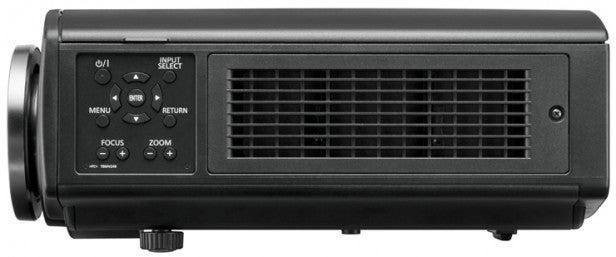
The last aspect of the AT6000E’s performance to cover is its running noise. This is generally very acceptable for such a prodigiously bright projector, to the point of being practically inaudible if you’re using the Eco lamp setting. You can become aware of a whir when watching 3D – when the lamp is running hardest – but only if you’re sat quite close to the projector. So you should be able to easily work around this issue given the Panasonic PT-AT6000E’s impressive set up flexibility.
Panasonic PT-AT6000E Verdict
Panasonic has kicked the new projector season off in spectacular style with the Panasonic PT-AT6000E. Pretty much every part of it has been either tinkered with or completely rebuilt versus its predecessor, resulting in a projector that’s good with 3D and outstanding with 2D, setting new standards for LCD projection technology. As noted at the start of this review there are some tantalising other projectors in the offing over the coming weeks, but it’s fair to say the Panasonic PT-AT6000E has set the bar mightily high.
Trusted Score
Score in detail
-
Value 9
-
2D Image Quality 10
-
Features 9
-
3D Image Quality 8
-
Design 8
Features
| Native Aspect Ratio | 16:9 |
| Projector Type | LCD |
| Brightness (Lumen) | 2400lm |
| Contrast Ratio | 500,000:1 |
| Resolution | 1920 x 1080 |
| Full HD 1080p | Yes |
| 3D Ready | Yes |
| Max Diagonal Image Size (Inch) | 300in |
| Lamp Type | Red-rich UHP |
| Lamp power (Watt) | 220W |
A/V Ports
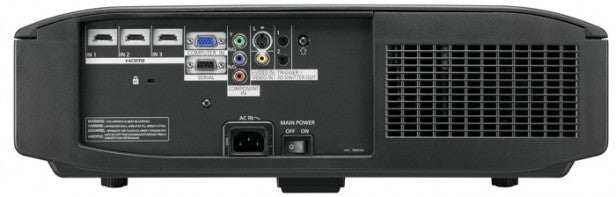
| HDMI | 3 (v1.4) |
| Component | 1 |
| Composite | 1 |
| S-Video | 1 |
Physical Specifications
| Height (Millimeter) | 151mm |
| Width (Millimeter) | 470mm |
| Depth (Millimeter) | 364mm |
| Weight (Gram) | 8700g |


Editorial independence
Editorial independence means being able to give an unbiased verdict about a product or company, with the avoidance of conflicts of interest. To ensure this is possible, every member of the editorial staff follows a clear code of conduct.

Professional conduct
We also expect our journalists to follow clear ethical standards in their work. Our staff members must strive for honesty and accuracy in everything they do. We follow the IPSO Editors’ code of practice to underpin these standards.
Editorial independence
Editorial independence means being able to give an unbiased verdict about a product or company, with the avoidance of conflicts of interest. To ensure this is possible, every member of the editorial staff follows a clear code of conduct.
Professional conduct
We also expect our journalists to follow clear ethical standards in their work. Our staff members must strive for honesty and accuracy in everything they do. We follow the IPSO Editors’ code of practice to underpin these standards.