

Verdict


Pros
- Stunning looks and build quality
- Crisp, detailed sound with solid bass and midrange
- Funky touch sensitive controls
Cons
- No remote
- Should have more sockets
- Slight over-emphasis on treble
Key Specifications
- Review Price: £629.00
- Distinctive spherical design
- Magic Touch control system
- Active speaker with 2 x 40W amplifier
- 42mm aluminium basket woofer and 19mm neodymium tweeter
- Minijack input
NACSound was founded by Italian acoustics guru Francesco Pellisari in the late 90s, and Geminos is his latest brainchild. Or should we say brain children – Geminos means ‘twins’, not only a reference to the two identical speakers but also to Pellisari being an identical twin himself and the father of twin girls.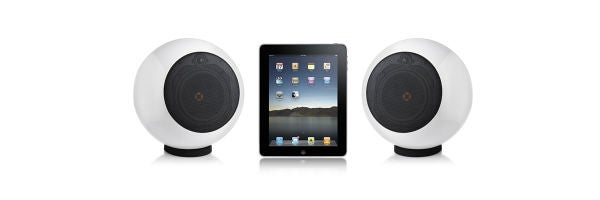
Design
It’s (they are? – Ed.) a stereo speaker system designed with iPads and iPods in mind, aiming to combine solid sound quality with a splash of Italian panache. And sure enough they’re an immensely stylish pair, each one a 25cm diameter sphere dressed in a seriously luxurious high gloss white finish. This makes them feel incredibly solid and weighty, which impressed us as soon as we lifted them from their equally chic cylindrical packaging.

Like monozygotic human twins, the two speakers look identical but they’re actually not. One of them is an active speaker containing an amplifier, which has to be plugged in to the mains and hooked up to the passive speaker using a supplied cable. These awesome-looking orbs sit on spongy neoprene rings, which let you point them any way you want. It’s a basic but effective tabletop mounting option. The speakers are quite imposing and will take up a fair chunk of your desk space if used with a PC for example, but with such a gorgeous design that’s not a big problem.
But here’s the part that’ll really make you go ‘ooh’. The active speaker incorporates a Magic Touch control system, which allows you to adjust volume or turn it on and off by simply holding your hand on the sides. One side increases volume, the other decreases, and to turn it on or off you have to hold both sides simultaneously. It’s very cool and likely to impress your mates, but it’s a shame there’s no remote control for those times when you’re not up close.
Through the mesh on the front of the active speaker you can see a row of four blue LEDs that indicates the volume level. When altering volume, the lights illuminate half way then fully, giving you eight incremental steps. The Magic Touch system works well, responding instantly to our commands but it’s not so sensitive that you accidentally turn up the volume every time you touch it.

Connections
On the back of the active speaker is a port housing the connections. Alongside the input for the mains adapter is a 3.5mm line input and a socket for the cable that links the passive speaker, and that’s it – there’s no USB for direct connection of iPods to keep signals in the digital domain, and no digital/analogue inputs for other kit. Thankfully, that versatile mini-jack input covers most bases.
Features
Geminos’ design is based on the Zemi, another of Pellisari’s speaker creations. That applies to the internal structure too, which uses NACSound’s patented central reflex technology, where a variable section pipe passes through the middle of the sphere.
Each speaker features a 142mm aluminium basket woofer and 19mm neodymium tweeter, the close correlation of which results in excellent linearity, according to NACSound. The speakers have a relatively wide frequency response of 38Hz – 21kHz, and the amplifier inside the active speaker offers 2 x 40W of power, which on paper looks like a decent amount of grunt.
Performance
And in practise, Geminos is a highly polished and powerful performer, injecting music with the sort of richness and depth you’d hope for when forking out over £600 on a set of speakers.
It reveals plenty of detail and texture in the music, thanks to its remarkably clear and fleet-footed handling of high frequencies. This gives it an open, airy nature that makes any material you play sound gratifyingly crisp and perky. If anything, it might over-emphasise treble a touch too much, but because it’s balanced out by solid, forceful midrange and chunky bass notes it doesn’t spoil the sound.
We played tunes from an iPad, a laptop and even a portable CD player, and in each case Geminos lends genuine sparkle to the music. Lossless music files and CDs obviously showcase its talents best, but even standard 192/128kbps MP3s and AAC files sound terrific. Stereo imaging is excellent, and the speakers have enough puff in their lungs to fill an average-sized living room.

So whether you’re playing the future soul of Sy Smith’s Fast and Curious, the iconic jazz of Miles Davis’ Kind of Blue or belligerent guitar music like Nirvana’s Nevermind, Geminos handles it with a refinement and poise befitting its price tag, backed up by tightly integrated and agile low frequencies.
Next we tried Geminos with movie material stored on our laptop, and even though it’s not the system’s primary function the speakers’ inherent quality shines though. Its prowess with detail is its main asset, fleshing out the stereo soundstage with delicate background ambience and effects while giving music and dialogue due prominence.
Verdict
With its classy musical performance and scene-stealing looks, Geminos has proved that it’s truly one (or two?) of a kind. It lends a detail-drenched gloss to tunes from any source, backed up by authority in the mid and low frequencies, resulting in a polished sound with plenty of depth. Some may find it pushes the high-frequencies a little too much, but others will lap up the crispness it brings to the sound.
It’s also beautifully built, blessed with Italian aesthetic flair and boasts some cheeky little innovations like the Magic Touch control system, which ups the wow factor even further.
But does all this justify the not insignificant £629 price tag? Almost, but we’d have liked a couple more connections and a remote control for the money, plus the foam rings aren’t the most elegant of mounting solutions. Aside from that though, this is an impressive proposition.
Trusted Score
Score in detail
-
Design 10
-
Sound Quality 9
-
Features 8
-
Value 6
-
Usability 9
Physical Specifications
| Weight (Gram) | 7000 (ross)g |


Editorial independence
Editorial independence means being able to give an unbiased verdict about a product or company, with the avoidance of conflicts of interest. To ensure this is possible, every member of the editorial staff follows a clear code of conduct.

Professional conduct
We also expect our journalists to follow clear ethical standards in their work. Our staff members must strive for honesty and accuracy in everything they do. We follow the IPSO Editors’ code of practice to underpin these standards.
Editorial independence
Editorial independence means being able to give an unbiased verdict about a product or company, with the avoidance of conflicts of interest. To ensure this is possible, every member of the editorial staff follows a clear code of conduct.
Professional conduct
We also expect our journalists to follow clear ethical standards in their work. Our staff members must strive for honesty and accuracy in everything they do. We follow the IPSO Editors’ code of practice to underpin these standards.